

How AI Is Changing Marketing in 2026: The Strategy Shift Every Business Needs to Make

Marketing is always changing. Sometimes the pace is so fast even pros feel like they may trip over our own feet trying to keep up (ask me how I know).
AI has only made that challenge greater. But, as with most things, the challenges and pitfalls that AI presents (thankfully) also come with new and greater opportunities. The trick is to recognize what they are and jump on them before your competition.
Here’s the short version: AI has fundamentally flipped the traditional marketing playbook. Your website is no longer the center of your customer’s decision-making process – AI is. To grow in 2026, businesses need to shift from push marketing to pull marketing, show up authentically in online conversations, and optimize their websites to be understood by both humans and AI.
Below, we’ll break down exactly what’s changed and what to do about it.
How Has AI Changed the Way Consumers Research and Buy?
The opportunity that AI offers doesn’t only lie with making your internal operations more efficient. It’s equally critical to understand how it’s changing the ways in which your customers or clients research products and services.
A simple Google search used to be at the top of the list when consumers were looking to find what they needed. And most often it still is, but not in the same way.
When users google a product or service, they’re no longer always served up a few sponsored results followed by the top 10 ranked results. Instead, what they often see first is a response generated by Google’s AI assistant, Gemini.
Others are skipping the Google search altogether and going straight to the source: asking ChatGPT, Claude, or other large language model platforms for recommendations.
A 2026 study of tens of millions of U.S. users found that Google searches per person dropped nearly 20% in a single year — driven largely by AI-powered answers that reduce the need for follow-up searches.
What’s fueling this shift? The same thing that’s fueling businesses to incorporate AI into their operations at breakneck speed: unparalleled efficiency.
Rather than googling about their need or question and then clicking through a long list of websites and reviews to make their decision, AI can now do that work for them – and do a much better job of it.
What might have taken an hour or more for a human to research can be done on a much more comprehensive scale by AI in seconds. And not only that, it’s presented to the user for consideration all wrapped up in a proverbial robotic bow complete with pros, cons, and a summary of overall satisfaction (or not) from others – like the all-powerful word-of-mouth on steroids.
It’s Not Just AI – It’s a Trust Shift, Too
Here’s the thing: AI didn’t create this shift out of thin air. It accelerated something that was already happening.
People were already growing weary of polished corporate messaging and too-good-to-be-true promises. They were already turning to Reddit threads, Facebook groups, and online reviews to hear what real people had to say before making a decision. The desire for authentic, transparent, human connection in a world full of sales pitches? That was there long before ChatGPT entered the chat.
What AI has done is supercharge that tendency. It takes all those scattered conversations, reviews, and real-world experiences and distills them into a single, digestible answer. In other words, AI has turned people’s natural distrust of marketing-speak into a full-blown shortcut – one that lets them bypass the brochure and go straight to the verdict.
So now you’re not just competing with other businesses for attention. You’re competing with the collective voice of every customer, reviewer, and commenter who’s ever mentioned your brand – or your competitor’s brand – anywhere online.
How the Marketing Hub-and-Spokes Model Has Flipped
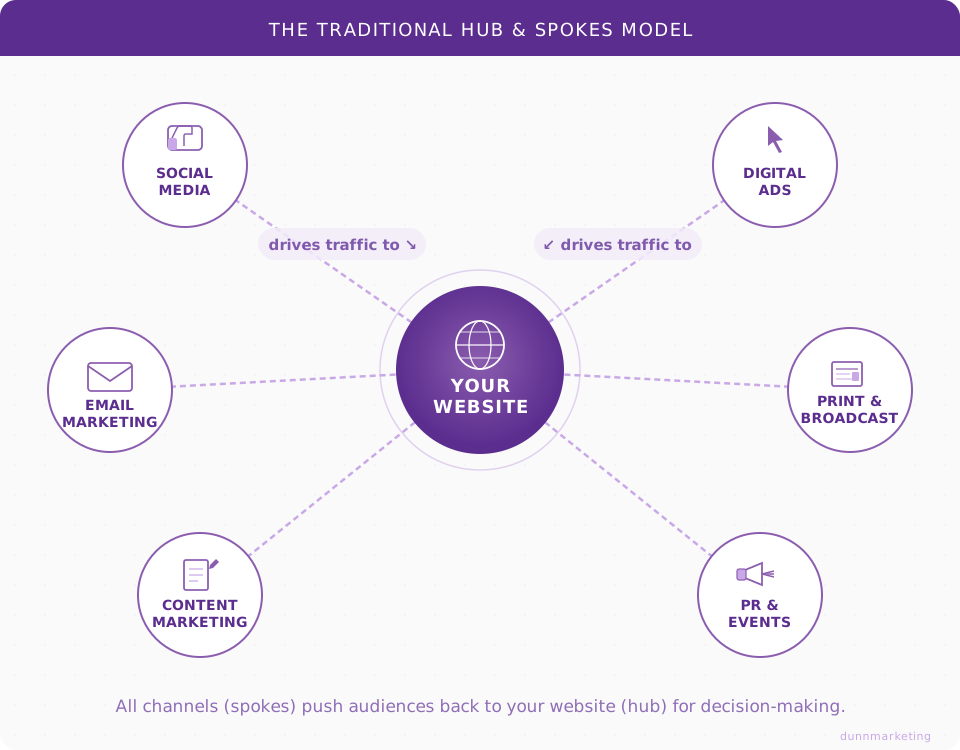
Back in the old days – say, pre-2024 – digital marketing worked on a hub-and-spokes model. Your website was the hub, and all your advertising and marketing (the spokes) led back there. The goal was to use those spokes – social media, digital advertising, email marketing, even traditional print and broadcast marketing – to get people back to your website. That’s where they sized you up and decided if they wanted what you have to offer.
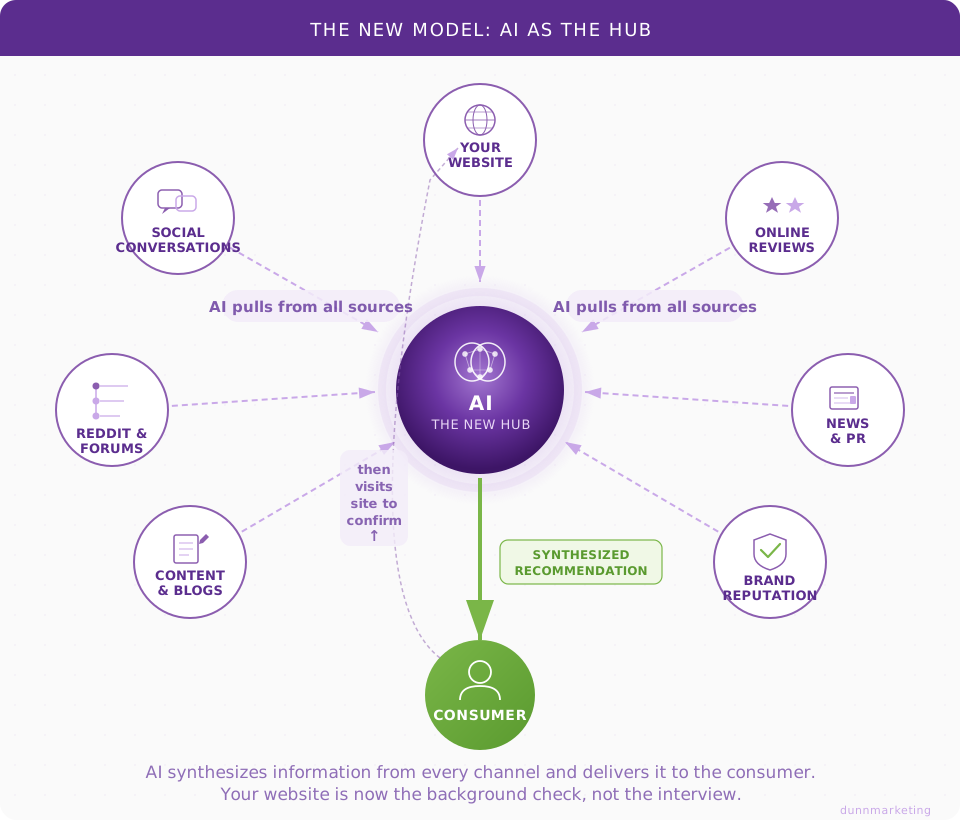
Now, that model has been flipped on its head. AI has become the new hub – the place where information from all your “spokes” is gathered, synthesized, and served up to consumers in one place. Your website, your social media presence, your reviews, the conversations happening about you on Reddit and in Facebook groups – AI pulls from all of it to form its recommendations.
It’s getting more and more rare for people to use a company’s website as their first and one-stop shop for decision making. Between the authentic peer-to-peer conversations happening on social platforms and AI’s ability to distill all of that into a neat little package, consumers are more likely to have made up their mind before they even land on your homepage.
Potential customers will still visit your website, but now it’s more likely to be the last stop on the research train before they decide that’s actually where they want to get off.
In other words, websites are becoming more like the background check rather than the interview.
How to Win at Marketing in the Age of AI: Always Be Pulling for Your Customers
So, what does this mean for how you market your business today? Focus on the spokes – but not in the way you used to.
Anyone with experience in marketing knows that there are two types: push marketing and pull marketing. Push marketing is focused on pushing your message out to consumers with the goal of short-term sales. Pull marketing focuses on building awareness and loyalty with consumers over the long term by providing value apart from the transaction.
Essentially, push marketing is more like a one-night stand, whereas pull marketing is the long courtship and healthy relationship stuff of a Nicholas Sparks novel. It’s about connection, meeting your partner (customer) where they are, and communicating and behaving in a way that says, “I’m in this for the long haul, because I care about you and your needs.”
In the old hub-and-spokes model, the spokes were largely a “push” play – pushing people back to your website to close the deal. But in today’s landscape, the winning strategy is to push your value out into the world and let it pull people to you.
That means showing up authentically in the places where conversations are actually happening: on social media, in online communities, through valuable content that educates and helps rather than just sells. It means being genuinely useful in the discourse – not because you’re trying to manipulate it, but because that’s what builds the kind of trust and reputation that AI picks up on and serves back to consumers.
When someone asks ChatGPT for a recommendation in your industry, the brands that show up are the ones with the strongest pull footprint – the ones creating valuable content, earning genuine praise, and contributing meaningfully to conversations across the web.
At Dunn Marketing, this philosophy is at the core of everything we do. Our Empathy-Driven Brand Building™ approach has always been rooted in the belief that authentic connection drives real results. The age of AI hasn’t changed that principle – it’s made it more important than ever.
How to Optimize Your Website for AI Search
Your website still matters – a lot. But its role has shifted, and how you build and maintain it needs to shift along with it.
In a world where your website is more often the background check than the first impression, it needs to do two things exceptionally well: confirm the good things people have already heard about you, and be easily understood by AI.
Reinforce Your Reputation
When a potential customer lands on your site after AI or peer conversations have already piqued their interest, your website needs to reinforce that trust. This is where pull marketing principles apply on your own turf: lead with value, not sales pitches.
Feature genuine testimonials and case studies prominently. Share your expertise through helpful content. Be transparent about who you are and what you stand for. Make it easy for visitors to say, “Yep, this matches what I’ve heard – I’m in.”
Make Your Website AI-Friendly
Since AI is now the hub synthesizing information about your business, you need to make sure it can actually find, understand, and accurately represent what you do. This practice is increasingly known as Answer Engine Optimization (AEO), and it’s becoming just as important as traditional SEO. Here are the key steps:
Structure your content clearly. Use descriptive headings, organized page structures, and plain language that makes it easy for AI to parse what your business offers, who you serve, and what makes you different. AI systems extract information section by section, so each part of your website should be able to stand on its own.
Answer the questions your customers are asking. Create content pages or FAQ sections that directly address the questions people are typing into AI platforms. Think less “keyword stuffing” and more “being the most helpful answer in the room.”
Keep your information current and consistent. AI pulls from what’s available, so make sure your website content, Google Business Profile, and directory listings all tell the same accurate, up-to-date story. Inconsistencies confuse AI systems just as much as they confuse customers.
Build authority through quality content. Regularly publish helpful, expert-level content – blog posts, guides, resources – that demonstrates your knowledge and value. The more high-quality content AI has to draw from, the more likely it is to recommend you.
Use schema markup. This is the behind-the-scenes code that helps AI and search engines understand exactly what your content is about – your services, your location, your reviews, and more. If you’re not using it yet, it’s time to start.
Don’t abandon traditional SEO. AI optimization isn’t a replacement for search engine optimization – it builds on it. A 16-month BrightEdge study found that 54% of AI Overview citations came from pages that also rank in organic search results – up from just 32% when AI Overviews launched. A strong SEO foundation is still your ticket into AI’s consideration set.
The Bottom Line: Stop Marketing At People – Start Showing Up For Them
The businesses that will thrive in this new landscape are the ones that understand a fundamental truth: your marketing no longer lives on your website. It lives in every interaction, every piece of content, and every conversation that happens about your brand – online and off.
AI hasn’t just changed how people search. It’s changed what they trust. And what they trust is authenticity, helpfulness, and the real voices of real people. Your job is to make sure those voices have great things to say about you – and that when AI goes looking, it finds a brand that’s been showing up, adding value, and building genuine connections all along.
Stop marketing at people. Start showing up for them. The AI will notice. And more importantly, so will your customers.
Ready to rethink your marketing strategy for the age of AI? At Dunn Marketing, we help organizations across healthcare, education, finance, law, the nonprofit sector, and startups and growing businesses build authentic brands that connect, inspire, and convert – whether the audience finds you through Google, ChatGPT, or a conversation with a friend. Let’s chat about how we can fuel your success.
Frequently Asked Questions
How has AI changed marketing?
AI has fundamentally shifted the marketing landscape by becoming the new “hub” where consumers research products and services. Instead of visiting individual websites, consumers increasingly ask AI platforms like ChatGPT and Google’s Gemini for recommendations. AI synthesizes information from across the web – including social media conversations, reviews, and website content – to deliver consolidated answers. This means businesses need to focus on building a strong, authentic presence across all channels, not just their own website.
What is pull marketing, and why does it matter now?
Pull marketing is a strategy focused on attracting customers by providing genuine value – helpful content, expertise, and authentic engagement – rather than pushing promotional messages at them. In the age of AI, pull marketing matters more than ever because AI systems recommend brands that have earned genuine trust and positive mentions across the web. Businesses that consistently provide value are more likely to be cited in AI-generated recommendations.
What is Answer Engine Optimization (AEO)?
Answer Engine Optimization (AEO) is the practice of structuring your website content so that AI-powered platforms – like ChatGPT, Google’s AI Overviews, Perplexity, and Claude – can easily find, understand, and cite your business as a trusted answer to user queries. AEO builds on traditional SEO by emphasizing clear content structure, direct answers to common questions, consistent business information, and schema markup.
How do I optimize my website for AI search?
To optimize your website for AI, focus on these key practices: structure your content with clear, descriptive headings; answer your customers’ most common questions directly; keep your business information consistent across your website, Google Business Profile, and directory listings; publish authoritative, helpful content regularly; implement schema markup; and maintain a strong traditional SEO foundation. A BrightEdge study found that the majority of AI-generated citations come from pages that also rank well in organic search.
Is SEO still important in 2026?
Yes. SEO remains the foundation of digital visibility. A 16-month BrightEdge study found that 54% of AI Overview citations overlap with pages that rank in organic search results – and that number has been growing steadily since AI Overviews launched. Traditional SEO and AI optimization (AEO) work together – strong SEO gets your content into AI’s consideration set, while AEO-specific practices increase the likelihood that AI will actually cite and recommend you.
*AI may have been utilized for research and editing of this post.